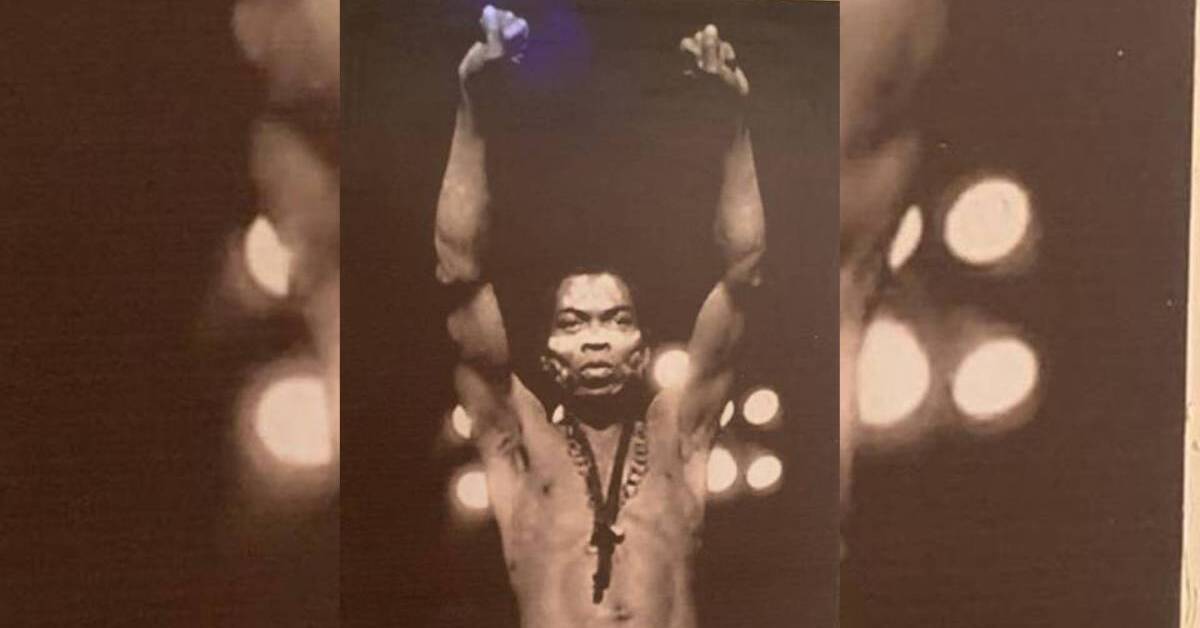
Fela Kuti Black Man’s Cry takes me back to something I encountered as a young boy and did not fully understand at the time. Fela Anikulapo Kuti was one of the influences I grew up with, and his music made me think about Africa, identity and consciousness.
The line in the song that stayed with me was a simple but powerful question about Black skin: “talo so pe awo dudu ti mo gbe sara mi oda o?” (who said that the Black skin I wear is not good)? The song is officially listed as “Black Man’s Cry” and appears on Fela’s Live with Ginger Baker recording from 1971.
That line woke me to the reality of Fela. I remember hearing it as a young boy and my first reaction was, “Who is this man?” I did not have all the words to explain what I was hearing. But I understood that he was questioning something that many people had simply accepted.
How we see ourselves: Fela Black Man’s Cry
The song goes beyond appearance for me. It raises a broader question about how Black people see themselves and what happens when we begin to believe that what we naturally have is somehow less valuable.
Fela’s words are direct. The song challenges the idea that Black skin needs to be changed or regarded as inferior. Contemporary descriptions of the song also connect it with Black consciousness and pride.
I have repeated that question so many times in mind because I have encountered versions of it outside skin colour.
When I founded Jidaw Systems, there were suggestions that the name Jidaw sounded too African and that something more foreign sounding might appear more credible.
I decided to keep Jidaw.
At the time, it was a business decision. Looking back, I see it as part of a much wider issue. Why should an African name need to sound foreign before it is considered credible? Why do we sometimes assume that something is better simply because it appears to have come from somewhere else?
I have seen this thinking in many areas. It can appear in the way we regard African names, accents, languages, hairstyles and cultural practices. It can appear in the products we trust and the ideas we consider sophisticated. It can even appear in the way we wait for foreign recognition before we fully appreciate something that has been created or achieved here.
I am not arguing that everything African is automatically better. That would simply reverse the same mistake. There is a lot to learn from the rest of the world, and Africa needs global collaboration, knowledge exchange, investment and access to technologies developed elsewhere.
The issue is the assumption that foreign automatically means better.
That distinction matters to me.
We should be able to appreciate something from another country because it is good, not because it is foreign. We should be able to learn from other cultures without feeling that our own culture is inferior. We should be able to use technology developed elsewhere while developing the capacity to create our own.
That is also where this question connects with my work in technology.
We have made significant progress in the digital space.
But I have also consistently believed that it is not enough to have technology. People need the capacity to use it, understand it, develop it and eventually create new technologies themselves.
For me, it is a matter of authentic, cultural confidence.
If we are constantly looking to outsiders for validation, we can become very good consumers of other people’s ideas without developing enough confidence to create our own, to bring out what we have within, to build what our reality, our experiences need.
Fela Black Man’s Cry connects to Digital Independence
Africa needs to participate in the digital economy as a creator, not simply a consumer; as an innovator, not just an onlooker; and as a driver, not just a passenger.
That does not mean rejecting global technology. It means developing the confidence and capacity to shape how technology works in our own environments and for our aspirations.
We can be technologically advanced and still stay true to our roots.
Our culture should not simply be preserved as something from the past. It should also be present and authentic in the digital and technological environments we create.
This is one reason Fela’s music remains relevant to me.
He did not simply entertain. He challenged people to think about who they were and how they saw themselves. His approach was often confrontational, and not every position he took is one I would necessarily endorse. But the underlying insistence on consciousness and self definition has remained important to me.
As I have grown older, I have also come to understand that identity is not about isolation.
We do not have to reject the world to identify with Africa.
We do not have to reject foreign ideas to value African ideas.
We do not have to reject technology developed elsewhere to build African technological capacity.
We do not have to choose between being global and being African.
The real challenge is being confident enough in who we are to engage with the world on our own terms, for our own purpose.
That is why the question in Fela’s song still speaks to me.
Who said that what we have is not good?
Who said that an African name needs to sound foreign before it can be credible?
Who said that our ideas need outside approval before we can take them seriously?
Who said that our culture belongs only in the past while technology belongs to somebody else?
These are not questions about rejecting others. They are questions about how we value ourselves.
And perhaps that is the deeper lesson I took from Fela while growing up.
Perhaps that is what Fela’s question still asks of me: not whether everything we have is perfect, but whether we have learned to value it enough to improve it, build on it and take it into the world with confidence.
Who said that what we have is not good?
Author: Jide Awe
Science, Technology and Innovation policy advisor.
Nigeria’s Inaugural Tech Mentor of the Year
Find him on LinkedIn: Jide Awe on LinkedIn
Find him on TikTok: ji.daw on TikTok
Find him on Twitter: @jidaw